
Legal
Tattoo Aftercare Instructions
Effective July 9, 2026 · Last updated July 9, 2026
These are the aftercare instructions you acknowledged when you signed the event waiver (Exhibit A). This is not medical advice — Tattiez and its artists are not medical professionals. If you see signs of infection or have any medical concern, contact a licensed medical professional immediately.
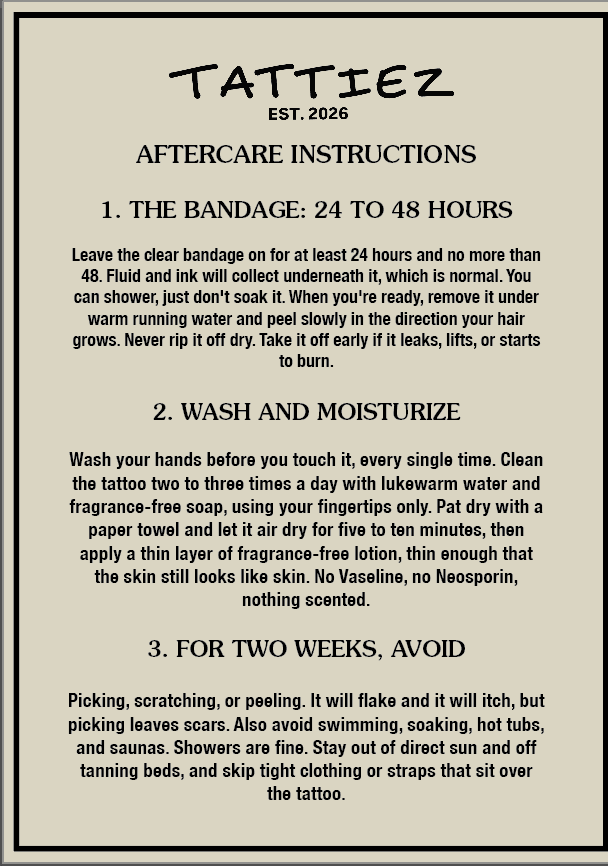
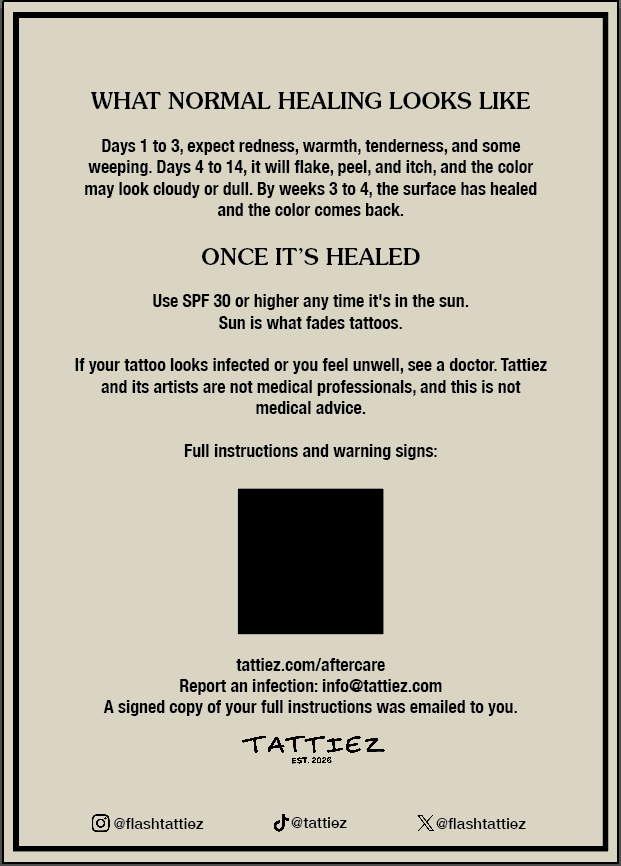
The card below is the same one handed out at the event — save it to your phone. The complete instructions and warning signs it points to follow underneath.
01Your bandage: the first 24 to 48 hours
Your artist applied a clear, breathable adhesive bandage, often called second skin, before you left. Leave it on.
- Leave the bandage on for at least 24 hours. Fluid, ink, and plasma will collect under it and may look cloudy or dark. This is normal and expected.
- Do not leave the bandage on for more than 48 hours, and remove it sooner if any of the conditions listed below occurs. Your artist may tell you a specific time within this range. Follow what your artist told you.
- You may shower with the bandage on. Do not soak it.
- To remove it, peel it off under warm running water. Find an edge, and peel it back slowly against itself in the direction of hair growth. Do not rip it off dry.
- Once it is off, wash the tattoo as described below, and leave it uncovered.
- Do not apply a new bandage yourself unless your artist specifically told you to.
Remove the bandage immediately, even if 24 hours have not passed, if any of the following happens:
- The bandage leaks, the seal breaks, or fluid escapes from under an edge. Remove it, wash the tattoo, and leave it uncovered for the rest of healing.
- The bandage comes loose, lifts, or bunches.
- You feel itching, burning, stinging, or you see redness, bumps, or a rash under or around the adhesive. You may be reacting to the adhesive. Remove the bandage immediately, wash the area, and leave it uncovered. If the reaction worsens or does not settle, contact a licensed medical professional.
02Washing and moisturizing (days 1 through 14)
- Wash your hands before touching the tattoo. Every time.
- Wash the tattoo two (2) to three (3) times per day with lukewarm water and a fragrance-free, dye-free, antibacterial or gentle liquid soap. Use your clean fingertips only. Do not use a washcloth, loofah, or scrub.
- Rinse thoroughly. Pat dry with a clean paper towel. Do not rub. Do not use a shared cloth towel.
- Let the tattoo air dry for five (5) to ten (10) minutes.
- Apply a very thin layer of a fragrance-free, dye-free healing ointment or lotion. Thin enough that the tattoo still looks like skin, not like it is coated. Too much product suffocates the tattoo and can cause breakouts.
- Do not use petroleum jelly, antibiotic ointment such as Neosporin, or scented lotions, unless a medical professional tells you to.
03Restrictions: do not, for at least two (2) weeks
- Do not pick, scratch, peel, or rub the tattoo. It will flake and itch. This is normal healing. Picking causes scarring and ink loss.
- Do not submerge the tattoo. No swimming pools, oceans, lakes, hot tubs, saunas, steam rooms, or baths. Showers are fine.
- Do not expose the tattoo to direct sunlight or use a tanning bed.
- Do not wear tight clothing, straps, watches, or jewelry over the tattoo.
- Do not shave over the tattoo.
- Do not let a pet lick or sleep against the tattoo.
- Do not go to the gym or engage in heavy sweating for the first 48 hours, and keep the tattoo clean afterward if you do.
04What normal healing looks like
- Days 1 to 3: redness, warmth, tenderness, mild swelling, and some fluid or ink weeping.
- Days 4 to 14: flaking, peeling, scabbing, and itching. The tattoo may look cloudy, dull, or faded.
- Weeks 3 to 4: the surface is healed and the color returns.
- Up to 3 months: the deeper layers of skin finish healing.
05Possible side effects
Every tattoo carries risk. The following may occur, even when the procedure is performed correctly and you follow these instructions.
- Pain, tenderness, swelling, redness, bruising, and itching at and around the tattoo site.
- Scabbing, flaking, peeling, and temporary skin sensitivity.
- Bacterial, viral, or bloodborne infection, whether localized or systemic.
- Allergic reaction to pigment, to the adhesive bandage, or to aftercare products. A pigment reaction may appear weeks, months, or years after the tattoo.
- Granulomas or nodules, which are small raised areas that can form around pigment.
- Keloids, hypertrophic scarring, or other permanent scarring.
- Pigment fading, migration, blowout, or discoloration, and hyperpigmentation or hypopigmentation of the skin.
- Fainting, dizziness, or nausea during or shortly after the procedure.
- In rare cases, swelling or burning at the tattoo site during a future MRI, or interference with a future medical imaging procedure.
- Permanent change in the appearance of your skin. A tattoo is permanent.
06Seek medical care immediately if you have any of the following
- Redness that spreads outward from the tattoo after day three.
- Red streaks running away from the tattoo.
- Pus, yellow or green discharge, or a foul odor.
- Pain, swelling, or warmth that worsens instead of improving after day three.
- Fever, chills, nausea, or feeling generally unwell.
- A rash, hives, blistering, or difficulty breathing, which may indicate an allergic reaction.
- A hard, raised, or growing lump at the tattoo site.
Do not wait. Do not contact Tattiez for diagnosis or treatment. Contact a licensed medical professional or, in an emergency, call 911.
07Sun protection after healing
Once the tattoo is fully healed, apply a broad spectrum SPF 30 or higher sunscreen to it whenever it is exposed to the sun. Sun exposure is the leading cause of tattoo fading.
08Reporting an infection, an adverse reaction, or a complaint
If you believe you have an infection or an adverse reaction, contact a licensed medical professional first. Then report it to Tattiez.
- Report to Tattiez by email at info@tattiez.com. Tell us the site of the reaction, the date you first noticed it, and whether you have sought or intend to seek medical treatment.
- Tattiez will report your infection or adverse reaction to the local health authority where required by regulation.
- You may also report an infection or injury, or file a complaint, directly with the local health authority for the municipality where your event took place. That authority's name, address, and telephone number are posted at the tattoo station.
09Questions
For questions about your tattoo or these instructions, email info@tattiez.com. For any medical question, contact a licensed medical professional.